Descended from Charlemagne? So Is Your Mail Carrier
A 1941 family letter says "We are all descendants of Charlemagne," and the maths of ancestry says it is probably true, just the wrong kind of true.
FactUnion VerifiedEvery fact on the episode's fact sheet was checked against its sources. Wrong facts were corrected. What this meansFacts checked 27 Oct 2026
Chapters (7)
About this episode
In 1941 a minister in the Pippin family wrote that they all descend from Charlemagne. A year later he admitted that proving it would be costly, and said family tradition made it too strong to deny. Ruth works the case with a doubling ancestor tree, a 2004 Nature paper on the common ancestry of all living humans, and a study of 2,257 Europeans that separates the ancestors on your family tree from the ancestors in your DNA. Danny defends the Pippins the whole way.
The verdict: probably true, but in a way that is true for almost everyone, and it may have left no trace in your genes. The part of your family history you can actually prove is sitting at your Thanksgiving table. This week, ask your parent which famous ancestor the family claimed, who first told the story, and how they said they knew.
Made by WovenPod. Hosted by Ruth and Danny, performed by synthetic voices. Supported by SagaSeal.
Facts and sources
Every fact used in this episode, with the sources it was checked against. Download as data
170 of 170 recorded lines matched the checked script.
The PLOS Biology study ‘The Geography of Recent Genetic Ancestry across Europe’ uses genomic data for 2,257 Europeans from the Population Reference Sample (POPRES) dataset.
The same study reports that it detected 1.9 million shared long genomic segments.
The abstract says a pair of modern Europeans in neighbouring populations ‘share around 2 to 12 genetic common ancestors from the last 1,500 years, and upwards of 100 genetic ancestors from the previous 1,000 years.’
The abstract says individuals from opposite ends of Europe are ‘still expected to share millions of common genealogical ancestors over the last 1,000 years.’
The study says ‘these genetic ancestors are a tiny fraction of common genealogical ancestors’ and that ‘these ancestors often do not contribute any genetic material to us.’
Show all 35 factsShow fewer facts
The PLOS Biology study by Peter Ralph and Graham Coop (UC Davis), published 7 May 2013, states: ‘given that each individual has 2^n ancestors from n generations ago, theoretical considerations suggest that all humans are related genealogically to each other over surprisingly short time scales.’
The study’s overall window is the past 3,000 years. Over that period, pairs from opposite ends of Europe share ‘hundreds of genetic common ancestors’ according to the Author Summary. That is a different quantity from the millions of genealogical ancestors over the last 1,000 years.
The study reports that shared genetic common ancestors ‘drop off exponentially with geographic distance.’
Rohde, Olson & Chang’s ‘Modelling the recent common ancestry of all living humans’ appeared in Nature 431, 562 to 566 (2004), doi 10.1038/nature02842.
The Nature abstract says that for a randomly mating population the most recent common ancestor of all living humans ‘would have lived in the very recent past.’
The abstract says the random mating model ‘ignores essential aspects of population substructure, such as the tendency of individuals to choose mates from the same social group, and the relative isolation of geographically separated groups.’
The abstract describes two structured models. A simple one is analysed with explicit mathematics. A more elaborate one is analysed by Monte Carlo simulation. It states ‘the MRCA of all present-day humans lived just a few thousand years ago in these models.’
The abstract also says that among all individuals living more than just a few thousand years earlier than the most recent common ancestor, each present-day human has exactly the same set of genealogical ancestors. No generation count or calendar date for this ‘identical-ancestors point’ appears in the sources.
Joseph Chang, alone, published ‘Recent common ancestors of all present-day individuals’ in Advances in Applied Probability, Vol. 31, Issue 4, December 1999, pp. 1002 to 1026, using a two-parent analogue of the Wright-Fisher model.
In Chang’s 1999 model the number of generations to the most recent common ancestor is concentrated around lg n, base-2 log of population size n, and all partial ancestry ends at about 1.77 lg n generations back. The standard one-parent Wright-Fisher model gives about 2n generations.
A paper on inbreeding and pedigree size asks how many generations ago the common ancestor of all present-day individuals lived and how inbreeding affects the estimate. It notes that ‘mating is often non-random and inbreeding is ubiquitous in natural populations.’
A 2023 Journal of Economic History article says ‘we have only a rough idea of the population of most parts of the globe before 1500.’
- We Do Not Know the Population of Every Country in the World for the Past Two Thousand Yearsdoi.org
- We Do Not Know the Population of Every Country in the World for the Past Two Thousand Yearscambridge.org
- We Do Not Know the Population of Every Country in the World for the Past Two Thousand Yearscambridge.org
The same article says McEvedy and Jones’s Atlas of World Population History (1978), the usual source, ‘includes many estimates that are little more than guesses.’ It quotes them on Germany: ‘There are almost no data on which to base a population estimate for Germany until we reach the late Middle Ages.’
Carl Zimmer’s National Geographic essay ‘Charlemagne’s DNA and Our Universal Royalty’, published 7 May 2013, includes the line: ‘Suddenly, my pedigree looked classier: I am a descendant of Charlemagne. Of course, so is every other European.’
A RootsWeb wiki page says editor Gordon L. Remington proposed guidelines for detecting genealogical fraud, citing his paper ‘Charlemagne or Charlatan: Case Studies in Genealogical Fraud,’ presented at the 1994 Federation of Genealogical Societies/Virginia Genealogical Society conference in Richmond, Virginia.
A university-hosted genealogy page on Charlemagne’s descendants and ancestors says its lineage does not agree with the ‘Ancestral Roots’ book, with Robert II missing from the Ancestral Roots lineage, but that this ‘does not change the blood line to Charlemagne.’
A DNAeXplained post dated 20 December 2015 on Charlemagne (742/748-814) says a birth date ‘would appear to suggest that Charlemagne was born illegitimately, which is not mentioned by Einhard.’
An essay on African ancestry and DNA testing says: ‘Genetics and DNA as the “great truth teller”, however, frequently yield results that go contrary to expectations.’
Tanya Evans’s article in the Journal of Family History (vol. 46, no. 1, 2021) draws on surveys and oral-history interviews with family historians in Australia, England and Canada. It says they use oral history, archival documents, material culture and space to ‘construct and reconstruct family stories.’
Mary Contini Gordon’s chapter ‘The Role of Memory in Family Oral History’ (Routledge, 2023) opens with two adult siblings disputing a childhood memory and mentions ‘the advice of a vibrant elderly uncle to fact check him which proved him right.’
The Italian result in the European study: ‘most common ancestors that Italians share with other populations lived longer than 2,500 years ago.’
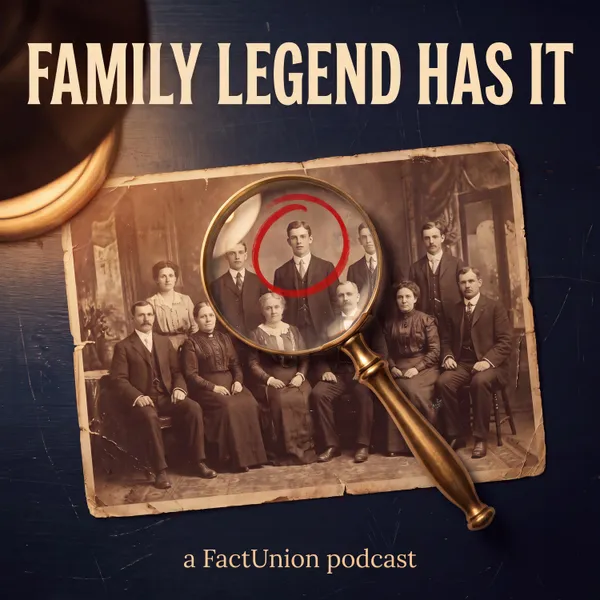
In a 1941 letter to Eva Luther Pippin, Rev. Walter W. Pippen, Jr. wrote: “We are all descendants of Charlemagne thru his son Pepin, King of Italy.”
Rev. Walter W. Pippen, Jr.’s typescript of about 1942 says: “It would be a costly task to authentically connect these lines with Charlemagne but family tradition and historical data make it too circumstantially strong to be reasonably denied.”
Yale’s 29 September 2004 release quotes Joseph T. Chang: “While we may not all be ‘brothers,’ the models suggest we are all hundredth cousins or so.”
According to the Yale release, Chang’s simplified model put the most recent common ancestor less than 1,000 years ago and the identical-ancestors point less than 2,000 years ago. The more realistic 2004 models put the common ancestor as recently as about 3,000 years ago and the identical-ancestors point as recently as several thousand years ago.
Nature News (29 September 2004) reports that Rohde’s team calculated that in 5,400 BC everyone alive was an ancestor either of all of humanity or of nobody alive today. The same report says the most recent common ancestor probably lived around 1,500 BC in eastern Asia.
On who the common ancestor was, Douglas Rohde told Nature News: “Maybe it was someone who happened to have 40 children or some such astronomical number.”
Nature’s News & Views commentary on the 2004 paper says: “had you entered any village on Earth in around 3,000 BC, the first person you would have met would probably have been your ancestor!”
A Generaggs essay dated 20 July 2026 splits ‘I descend from Charlemagne’ into four claims: statistical, genetic, documented and significance. It says: “The documented claim is almost always unproven for any given person and is the only one that carries genealogical weight.”
Davide Piffer (27 July 2026) reports that Lyman Stone argued pedigree collapse defeats the simple doubling proof and suggested there are almost certainly people in France who do not descend from Charlemagne. Piffer agrees the doubling argument is wrong and writes that without a connected population “’every European descends from Charlemagne’ is not a mathematical theorem.”
Checked but not used (1)
The Yale release quotes Chang: “Within two thousand years, it is likely that everyone on earth will be descended from most of us.”
Removed during checking (2)
In a family history dated July 1988, Harold F. Umstott of Charlottesville, Virginia, born 1907, wrote: "Through the DuBois Family Association we now have the line of descent from Emperor Charlemagne and the host of European Royalty."
The addendum to the same Umstott family history says information from the Swiss Embassy "sheds doubt on the story that a close relative of Moritz Schweizer was a President of Switzerland."