Who's in the Test Room
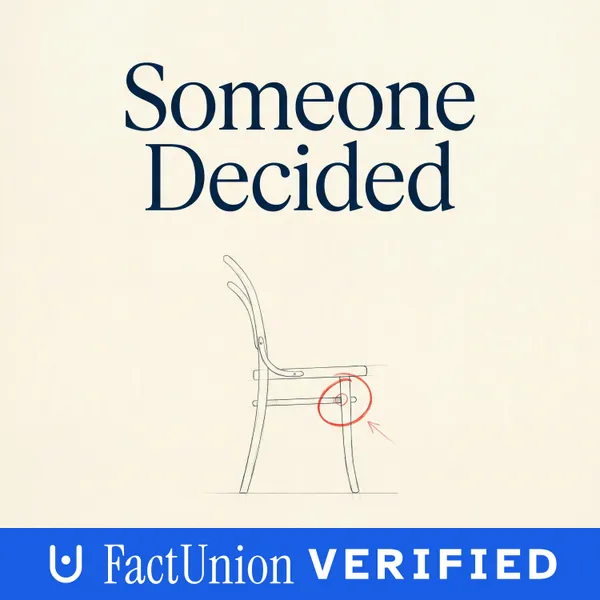
Nobody drew the child-resistant medicine cap; a test did, and for over twenty years the adults in that test were 18 to 45.
FactUnion VerifiedEvery fact on the episode's fact sheet was checked against its sources. Wrong facts were corrected. What this meansFacts checked 26 Oct 2026
Chapters (9)
About this episode
Somewhere this week, a child a little under four years old is handed a bottle and a stopwatch starts. The push-and-turn cap on your medicine was never drawn by Congress. It is whatever shape passes a test: enough preschoolers can't open it, and enough 'normal adults' can. Owen and producer Felix follow that test from a Windsor, Ontario paediatrician who was tired of pumping children's stomachs to the 1970 Poison Prevention Packaging Act, a 1986 study of real caps from real poisonings, and a 1995 vote about who counts as a normal adult.
The people the test left out were older adults, who take the most pills and struggled most with the caps. Their workarounds became a way in for their grandchildren. Today more than half of children's prescription-drug exposures involve medicine that has already left the bottle, and as far as our sources show, nobody has measured whether the 1995 fix worked.
Hosted by Owen and Felix, performed by synthetic voices.
Facts and sources
Every fact used in this episode, with the sources it was checked against. Download as data
182 of 182 recorded lines matched the checked script.
The Poison Prevention Packaging Act (Pub. L. 91-601) was enacted on December 30, 1970.
Before the Act, about 500 children aged 5 and under died each year of poisoning, according to Wikipedia.
The Act defines special packaging as ‘significantly difficult for children under five years of age to open’ and ‘not difficult for normal adults to use properly’, and excludes packaging ‘which all such children cannot open’.
CPSC states that ‘at least 85% of tested children must not be able to open the package during the first 5 minutes of the test, and at least 80% of tested children must not open the packaging during the full 10 minutes of the test.’
Child test panels are children aged 42 to 51 months, tested in sequential groups of 50, up to 200 children in total.
Show all 26 factsShow fewer facts
CHPA’s summary of 16 CFR 1700.20 says children are instructed on how to open the package and told they may use their teeth.
In the federal test, a child who opens the package counts as a ‘test failure’ for the package.
Push-and-turn caps have an outer shell that spins freely until the user pushes down to engage inside lugs, and vendors say children under five usually can’t coordinate both hands or follow steps in the right order.
Dr. Henri Breault (1909 to 1983) was Chief of Pediatrics and Director of the Poison Control Centre at Hotel Dieu Hospital in Windsor, Ontario, from 1957, and the Palm N Turn cap was adopted in the Windsor area in 1967.
Breault’s wife Monica recalled him saying: ‘I am tired of pumping children’s stomachs…I’ve got to do something about it.’
The 1986 study reported: ‘Grandparents’ medications accounted for a substantial number of episodes (17%).’
In the 1986 study, 200 (65%) of the 306 child-resistant containers received were ineffective; continuous-thread closures on liquid medicines failed 69% of the time, and wear caused failure in 52% of 73 lug-type containers.
In the 1986 study, 18% of incidents involved a closure not re-secured in a child-resistant manner.
CPSC Chairman Ann Brown said the original test procedures took effect in January 1972, and the Commission voted unanimously on June 15, 1995 to change the adult panel.
Brown said a 50 to 70 panel gives ‘a more realistic picture of the ability of normal adults to use child-resistant packaging properly than the current panel of 18 to 45 year olds’.
EPA’s summary of the rule says ‘some persons, especially older persons, find certain types of CRP difficult to open and re-secure properly’, so many either buy non-child-resistant packages or do not properly re-secure them.
The 1995 rule (60 FR 37710, July 21, 1995) substituted 100 adults aged 50 through 70 for the panel of 100 18-to-45-year-olds, with two test periods of 5 minutes and 1 minute.
The senior panel is 25% aged 50-54, 25% aged 55-59 and 50% aged 60-70.
Metal and aerosol containers were exempted from the senior panel and kept the 18 to 45 panel, and commissioners said they would revisit that exemption.
CPSC cited 130,000 emergency-room-treated poisonings in 1994 and 50 poisoning deaths of young children, and estimated over 700 children’s lives saved since the Act.
A CDC-led study of 4,496 calls to five US poison centres in 2017 found ‘Over half (51.5%) of exposures involving prescription medications involved children accessing medications that had previously been removed from original packaging,’ compared with 20.8% for OTC products.
In that study, grandparents’ medicines were involved in 30.7% of prescription exposures, and ADHD medicines (49.3%) and opioids (42.6%) were often not in any container when accessed.
CDC authors wrote that ‘most pill organizers are not child resistant and can be easily opened by young children.’
CDC epidemiologist Maribeth Lovegrove said: ‘Child-resistant caps don’t work unless adults use them properly by completely reclosing them immediately after each and every use.’
CDC data cited by Consumer Reports found that with a flow restrictor and no safety cap only 6% of children could empty a bottle in a 10-minute test, while 82% emptied a bottle with no restrictor and an improperly locked cap in under 2 minutes.
HRSA’s Up and Away campaign says more than 60,000 young children end up in emergency rooms every year from medicine poisonings.
Removed during checking (3)
Breault teamed up with Peter Hedgewick, president of ITL Industries, to develop the 'Palm N Turn' bottle cap in 1967.
Ontario made child-proof lids mandatory for medicine bottles in 1974.
CPSC's 1986 study covered oral prescription-drug ingestions reported to nine poison control centres from February to May 1986, involving 2,015 children.