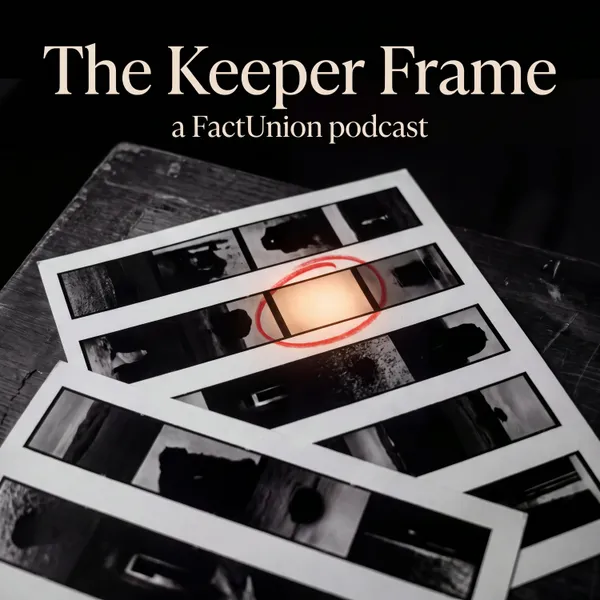
The Frame Behind the Hole
In the 1930s Roy Stryker's office punched holes through the government photographs it rejected. Years later, Ben Shahn went looking for one of those rejects because he needed it, and found it destroyed.
FactUnion VerifiedEvery fact on the episode's fact sheet was checked against its sources. Wrong facts were corrected. What this meansFacts checked 14 Oct 2026
Chapters (7)
About this episode
In the 1930s the Farm Security Administration sent photographers across America. Back in Washington, Roy Stryker's office decided which frames went into the file and "killed" the rest. Some of the killed frames got a hole punched straight through the negative. Today those wounded negatives hang in galleries as the censored pictures of the Depression. This episode puts the legend next to the record: who held the punch, what "killed" actually meant, and why the punching stopped in 1939. It starts with the day Ben Shahn went looking for a photograph of a storefront in Marked Tree, Arkansas, with the prices marked in Bon Ami, and found the negative destroyed.
There is no single famous keeper this time. This one is about the rejects. Most were near-duplicates, and every now and then one held the very thing the photographer needed years later. It's for anyone who has spent a long night deciding which frames live, and it ends with one idea to take into your next cull: choose the keeper, but don't destroy the alternates.
Made by WovenPod. Hosted by Mae and Gus, performed by synthetic voices. Supported by ShotBreak.
Facts and sources
Every fact used in this episode, with the sources it was checked against. Download as data
178 of 178 recorded lines matched the checked script.
Roy Stryker directed the Farm Security Administration’s photographic section and acted as its primary editor, selecting which negatives went into the agency’s print file.
The Library of Congress says rejected FSA/OWI images were classified as ‘killed’ and were usually near-duplicates or alternate views of images that were selected for printing.
According to the Library of Congress, a punched hole was one method staff used to mark certain killed negatives so they would not be printed: every hole-punched negative is a killed negative, but not every killed negative was hole-punched.
Not every killed FSA negative was hole-punched, and killed 35mm negatives without holes were kept alongside the selected images, often on the same film strip, and were never printed.
Carl Fleischhauer’s 2020 case study of John Vachon’s 1938 Roanoke Farms, North Carolina assignment found that of 384 photographs, 173 were selected and 211 were killed.
Show all 25 factsShow fewer facts
Of the 211 killed Roanoke Farms negatives, 68 carry a punched hole.
A visual survey of the FSA/OWI 35mm negatives available online, cited from Fleischhauer’s 2020 study, counted 4,233 punched holes.
A separate research account refers to 2,472 hole-punched negatives at the Library of Congress, a figure that has not been reconciled with the 4,233-hole count.
According to a Library of Congress bulletin quoted in the Archivaria article, Stryker and perhaps others in his office punched holes in negatives he felt were inferior or redundant.
There was no explicitly stated, consistent method for killing images: frames were rejected as redundant, technically flawed, or off-message, and decisions could be quick and influenced by Stryker’s personal preference or mood.
Stryker often chose somber, stoic portraits over candid moments of levity.
In his 14 April 1964 Archives of American Art oral history, Ben Shahn described Stryker as dictatorial in his editing and said he ruined valuable negatives by punching holes through them.
In that oral history Shahn recalls photographing a storefront in Marked Tree, Arkansas, where the prices were marked with Bon Ami.
Shahn says that during the war, while working for the OPA, he went looking for that negative to document the low prices, and found it had been destroyed by a hole punch.
Shahn’s words about his reaction were: “Well, I shot my mouth off about that.”
The Library of Congress FSA/OWI catalogue includes killed Ben Shahn negatives that carry punched holes.
FSA photographer Edwin Rosskam called the hole-punching barbaric; the primary source is his oral history with Louise Rosskam, recorded on 3 August 1965 for the Archives of American Art.
The hole-punching stopped in 1939 after persistent objections from photographers who saw it as destructive.
The punched negatives were not thrown away: they remained part of the FSA/OWI file of roughly 175,000 items that went to the Library of Congress.
Critics and some researchers have characterized the hole-punching as censorship, but an archivist’s survey of six series with potential for politically sensitive content found little evidence of cleansing, and the record suggests the punched negatives were mostly redundant or near-duplicate images that Stryker deemed unsuitable.
In 2018 London’s Whitechapel Gallery showed ‘Killed Negatives: Unseen Images of 1930s America’, curated by Nayia Yiakoumaki.
The Whitechapel exhibition argued that the rejected frames show the photographers’ original visions, sometimes including staged or official elements, and that the holes turn the negatives into objects viewed as contemporary art.
Artist William E. Jones made a work called ‘Killed’ from FSA punched negatives, discussed by The Paris Review in October 2010 under the title ‘Punctured’.
Photographer Bill McDowell published ‘Ground’, a book built from hole-punched FSA negatives, in 2016.
Writers on the killed negatives note that the black void of the punch often takes over the composition, so the reject is now seen less as a photograph than as a new, unintended image.