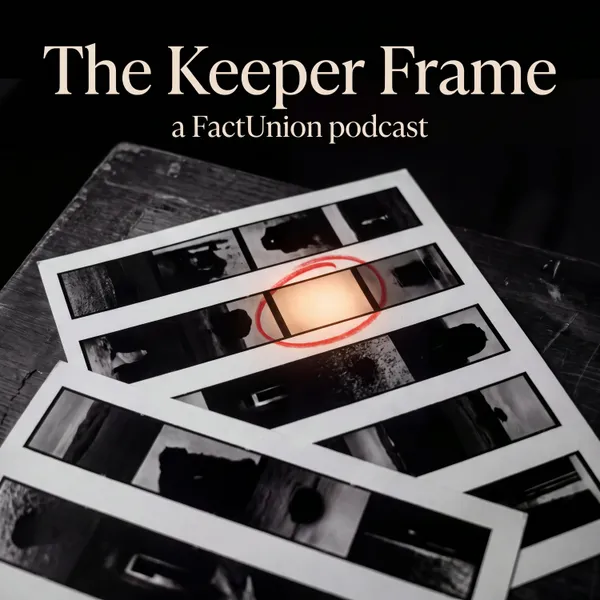
The Man Who Wouldn't Make the Good Pile
Garry Winogrand died with about 300,000 frames he never saw, and curators chose his keepers for him. The awkward part is that other people often chose them while he was alive, too.
FactUnion VerifiedEvery fact on the episode's fact sheet was checked against its sources. Wrong facts were corrected. What this meansFacts checked 22 Oct 2026
Chapters (8)
About this episode
In 1976, in a classroom above Nassau Street, Garry Winogrand sorted a student's prints into a good pile and a bad pile and gave no reason except "It's a good photograph." When he died in 1984 he left thousands of rolls nobody had looked at, and the people who came after him had to decide what a Winogrand was. John Szarkowski called the late work an engine that wouldn't stop. Leo Rubinfien, Erin O'Toole and Sarah Greenough argued it showed a man who was unhappy with his own celebrated style.
Mae and Gus go through the backlog, the verdicts and the record of who actually picked Winogrand's famous frames. Then they ask what that means for anyone sitting on an unculled hard drive tonight.
Hosted by Mae and Gus, performed by synthetic voices. Supported by ShotBreak.
Facts and sources
Every fact used in this episode, with the sources it was checked against. Download as data
213 of 213 recorded lines matched the checked script.
Garry Winogrand died on March 19, 1984, in Tijuana, Mexico, aged 56; he was born January 14, 1928, in New York City.
At his death Winogrand left about 2,500 rolls of undeveloped film, 6,500 rolls of developed but not proofed exposures, and about 3,000 rolls taken only as far as contact sheets.
Eyeshot describes the backlog as ‘Nearly 300,000 images that he never saw.’
Szarkowski had the unprocessed rolls developed, and he included only a small sample of the late work in the 1988 MoMA retrospective.
The last section of Szarkowski’s book ‘Winogrand: Figments from the Real World’ (MoMA) holds 25 pictures ‘chosen from the enormous body of work that Winogrand left unedited at the time of his death in 1984.’
Show all 22 factsShow fewer facts
Szarkowski wrote: ‘It seems to me that at the end Winogrand was a creative impulse out of control, and on some days a habit without an impulse, one who continued to work, after a fashion like an overheated engine that will not stop even after the key has been turned off.’
Szarkowski labeled part of Winogrand’s late work “unfinished work,” plagued with “crippling mechanical flaws,” and included only a small sample of it in the 1988 posthumous retrospective.
In his last years, Winogrand was not lazy or careless but dissatisfied with his celebrated self.
The 2013 retrospective was conceived and curated by Leo Rubinfien with Erin O’Toole of SFMOMA and Sarah Greenough of the National Gallery of Art, and it opened at SFMOMA on March 9, 2013.
- FIRST MAJOR TOURING EXHIBITION OF GARRY WINOGRAND’S WORK IN 25 YEARS DEBUTS AT SFMOMA · SFMOMAsfmoma.org
- First major touring exhibition of Garry Winogrand's work in 25 years debuts at SFMOMAartdaily.com
- San Francisco Museum of Modern Art opens retrospective by artist Garry Winograndmuseumpublicity.com
Rubinfien said of Winogrand: ‘He had always given editing a backseat to more shooting.’
Erin O’Toole said that today ‘most people see the value of viewing his unfinished work and know he often delegated his editing and printing,’ and that posthumous editing had ‘touched a nerve in the ‘80s.’
The NYT reports that Rubinfien devoted one-quarter of the 2013 catalogue to late work, ‘the vast majority of which Winogrand never reviewed’, and that 164 of its 401 plates are posthumous.
At the Met, posthumous prints were made at 11x14 so viewers could tell them from vintage prints, and the curators drew on ‘Winogrand’s own cryptic markings on some’ sheets while applying ‘fresh eyes to others.’
Collector Daily’s reviewer asked, ‘Do we really believe posthumous prints are a valid method for considering the images?’ and noted that ‘reasonable people will (and do) disagree.’
ARTnews reports that in the mid-‘60s Winogrand routinely handed visitors to his Upper West Side apartment stacks of photographs to sort, and that ‘he left the selections for his MoMA exhibitions and books almost completely in the hands of his friends and Szarkowski.’
ARTnews reports that when Winogrand donated 16,000 prints in 1983 to the Center for Creative Photography in Tucson, ‘he blew off the director’s entreaties to separate them into two simple piles, good and bad.’
Between 1969 and 1976 Winogrand made 6,500 prints for Tod Papageorge to select from for his 1977 MoMA solo exhibition and book, Public Relations.
The Boston Globe reports that the 2014 curators note Winogrand ‘delegated printing to others’ and ‘even delegated the selection of images for several of his books.’
In Mason Resnick’s account of a Winogrand workshop that began in August 1976 above Nassau Street in lower Manhattan, Resnick ‘excitedly showed Winogrand some 50 workprints’ after shooting eight rolls.
Resnick writes that Winogrand ‘divided them up into a good and a bad pile, then handed them to me without comment,’ and, pressed on why a print worked, ‘simply said, “It’s a good photograph.”’
The Met holds Winogrand’s ‘Los Angeles’ (1980 to 83), credited as a ‘Posthumous print made by Thomas Consilvio in 1987 for the Museum of Modern Art, New York.’
MoMA’s collection holds a Winogrand ‘Untitled, 1978-83’ gelatin silver print, ‘printed 1987 by Tom Consilvio’.
Checked but not used (1)
The Morgan acquired 5,783 Hujar contact sheets and two job books in 2013, while the negatives stayed with the estate.
Removed during checking (4)
Szarkowski, quoted in the NYT, said that of the contact sheets 'only a few of these bear the marks of even desultory editing.'
For the 2013 show Rubinfien examined more than 20,000 proof sheets; nearly 300 images were shown, and nearly a hundred were printed for the first time.
The Center for Creative Photography's finding aid records that its Winogrand archive began with a 1983 gift of the artist.
'Hujar: Contact' at the Morgan Library & Museum runs May 22 to October 25, 2026, showing more than 110 contact sheets and 20 enlargements curated by Joel Smith, and draws on the Morgan's collection of over 5,700 Hujar contact sheets.